
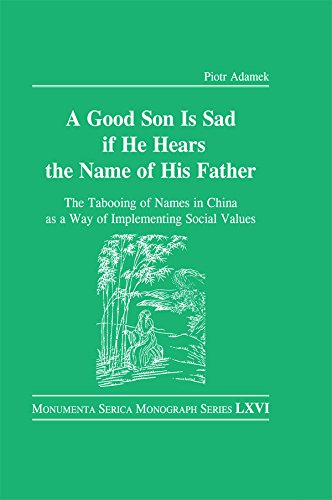
Good Son is Sad If He Hears the Name of His Father: The Tabooing of Names in China as a Way of Implementing Social Values (Monumenta Serica Monograph Series)
Product details
| Management number | 233425107 | Release Date | 2026/06/27 | List Price | $20.54 | Model Number | 233425107 | ||
|---|---|---|---|---|---|---|---|---|---|
| Category | |||||||||
When in 1775 the scholar Wang Xihou compiled a dictionary called Ziguan , he wrote, for illustrative purposes, the personal names of Confucius and the three emperors Kangxi, Yongzheng and Qianlong in the introduction. In oversight, he recorded their complete names. This accidental writing of a few names was condemned by Emperor Qianlong as an unprecedented crime, rebellion and high treason. Wang Xihou was executed, his property confiscated and his books were burnt. His family was arrested and his sons and grandsons were killed or sent as slaves to Heilongjiang. It is surprising what an enormous impact the tabooing of names (bihui ) had on Chinese culture. The names of sovereigns, ancestors, officials, teachers, and even friends were all considered taboo, in other words it was prohibited to pronounce them or to record them in writing. In numerous cases characters identical or similar in writing or pronunciation were often avoided as well. The tabooing of names was observed in the family and on the street, in the office and in the emperor's palace. The practice of bihui had serious consequences for the daily lives of the Chinese and for Chinese historiography. People even avoided certain places and things, and refused to accept offices. They were punished and sometimes even killed in connection with the tabooing of names. The bihui custom existed as an important element of Chinese culture and was perceived as significant by Chinese and foreigners alike. It was crucial for implementing social values and demonstrating the political hierarchy. The present work A Good Son Is Sad if He Hears the Name of His Father is a systematic study of Chinese name-tabooing customs, which until now have been relatively little explored in Western-language Sinological studies. It attempts to provide a long-term perspective on the changing dynamics of tabooing and elucidates various aspects related to the fascinating topic of tabooing of names. Read more
| ASIN | B0GF88L9SX |
|---|---|
| XRay | Not Enabled |
| ISBN13 | 978-1351565202 |
| Edition | 1st |
| Language | English |
| File size | 1.2 MB |
| Page Flip | Enabled |
| Publisher | Routledge |
| Word Wise | Not Enabled |
| Print length | 416 pages |
| Accessibility | Learn more |
| Screen Reader | Supported |
| Part of series | Monumenta Serica Monograph Series |
| Publication date | July 5, 2017 |
| Enhanced typesetting | Enabled |
Bestseller ranking
Paint Making Materials





Customers who viewed this product also viewed
Finish Nailers





Correction of product information
If you notice any omissions or errors in the product information on this page, please use the correction request form below.
Correction Request Form